
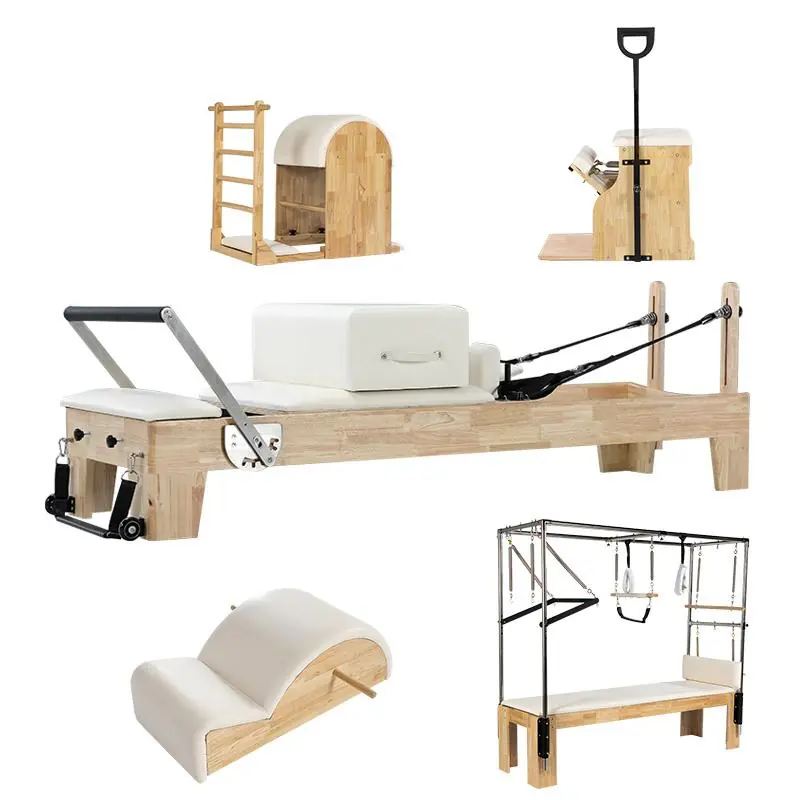
Step 1 — Count class slots, not equipment
Before any model number, count the timetable. A room with six reformers and eight classes a day is a different business from a room with six reformers and two classes a day. The number you want is class slots per week × clients per slot, because that is what tells you whether you are short of machines or short of hours. Equipment lists built from a photo of someone else's studio almost always overbuy the visible pieces and underbuy the props.
Step 2 — The floor equipment (reformers)
Reformers first, always: they carry the majority of class hours and they set the room's species. In our 2026 range there are 46 models across three frame lines — aluminium (27), folding (8) and solid wood (11) — and the full table with packing sizes and gross weights is on the reformer page. Two rules that save money later:
- Standardise the fleet. Buy the same model for every station in a room. Mixed fleets make maintenance, spares and replacement parts harder than they need to be.
- Buy one spare station's worth of parts, not one spare machine, at first. The parts that wear are small; the machine that waits in a corner is capital doing nothing.
Step 3 — One vertical station: tower or Cadillac
Choose based on how you teach. A tower integrates vertical work into a reformer footprint (the tower range has 11 models); a Cadillac gives you a raised table for assessment and supported work. New studios usually get more timetable flexibility per unit of spend from a tower. Studios with a rehabilitation or assessment-heavy clientele usually need the Cadillac.
Step 4 — The density pieces: chair and barrel
A Wunda chair and a ladder barrel change what you can teach far more than a second reformer does, and they fit in the corners the reformers cannot use. Buy one of each before expanding the reformer row. Both are often ordered in the same container as the reformers, which keeps freight down.
Step 5 — Props and small apparatus
This is the step that raises class revenue without new floor space: spine correctors, rings, mats and support pieces. They also double as retail test lines — if a prop sells in your studio, it will sell in your wholesale customers' studios. The studio set page groups the pieces studios reorder most, and specialty covers the rest.
Copyable opening checklist
| Stage | What to order | Why now |
|---|---|---|
| Opening | Reformers — one standardised model, enough stations for your peak class | Carries class revenue from week one |
| Opening | Mats and small props for the same peak class | Cheapest way to lift room capacity |
| Month 2–3 | One tower or one Cadillac | Widens the timetable without new floor space |
| Month 3–6 | One chair, one barrel | Small footprints, large teaching range |
| Month 6+ | Second row of reformers, spares, second barrel | Funded by proven class demand, not by hope |
What the plan should say about the room
Every item above has a delivery and storage consequence. Before you order, confirm door clearance for the crates, the route into the room, and where units live when they are not in use. A 220 kg case does not move because someone decided to rearrange the room — plan the layout with the published packing sizes; the layout guide shows the arithmetic.
Buying for a group of studios or a franchise
Franchises and multi-site operators should invert the order: standardise one reformer model and one tower across all sites first, then roll out. Franchise consistency is worth more than per-site optimising, because a member who changes branch should find the same machine under them. See gyms & fitness clubs and retail & private label for the two buying patterns we see most.
Frequently asked questions
What equipment does a Pilates studio need to open?
For a first room: enough reformers of one standardised model to fill your peak class, mats and small props for the same class size, then one tower or Cadillac within the first few months, then a Wunda chair and a ladder barrel, and finally a second reformer row funded by proven demand. Buying props late is the most common and most expensive sequencing mistake.
Should I buy one big reformer order or expand in stages?
Expand in stages, but standardise from the first order. Buy one model across all stations so spares, servicing and reordering stay simple, then add a second row once the timetable is full. Staged buying also lets you fund the next stage from actual class revenue instead of from a projection.
How many reformers do I need for a group class?
Count your peak class size, then add the props, not the machines, that let that class run well. If your peak class is six, six reformers is the base and the difference between a profitable room and a cramped one is usually mats, rings and correctors — small apparatus that raises what a full room can do.
Which small apparatus do studios reorder most?
Spine correctors, Pilates rings, mats and support pieces. They raise class density without new floor space, they wear faster than frames, and they are the easiest items to test as retail lines. Our studio set page groups the pieces studios ask for repeatedly.
Can a studio order equipment gradually from the same factory?
Yes, and it is the normal pattern. Because reformers, towers, chairs, barrels and small apparatus are built in the same workshop, staged orders can be combined into one shipment when schedules allow, which keeps freight cost down while the studio grows.
Our methodology
Every packing size, gross weight and model count in this guide is first-party data. We measured every packed unit ourselves — the crate is closed, weighed and dimensioned by our own QC team at the plant in Jinjiang, Fujian — and where a model ships in two packing configurations, both crates are recorded separately because they are genuinely different crates. We measured 80 models across 8 families before writing the staging table, and the order below follows the sequence in which studios we supply actually buy them.
Two consequences matter when you compare suppliers:
- Published means measured — and measured means packed. The figure describes the crate that has to arrive at your door, not the assembled machine in a showroom.
- Gaps stay gaps. Where a model’s material or gross weight is not disclosed, the table shows “—”. We do not estimate a number to fill a cell.
Sources
Two general references are used for the vocabulary in this guide. Neither is a product claim, and neither is affiliated with SANFAN.
- Pilates — the movement system, and the conventional names for its apparatus.
- Joseph Pilates — the origin of the method this equipment is built for.