
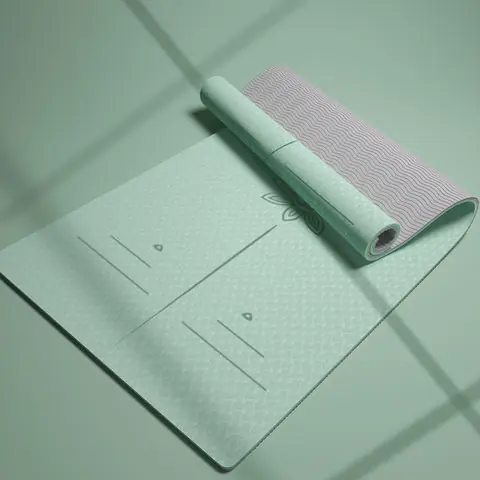
Specify a yoga mat with four numbers. Thickness: 3 mm (1/8") for travel and balance work, 4–5 mm (5/32"–3/16") as the general-purpose standard, 6 mm (1/4") for beginners and sensitive joints, 8–15 mm (5/16"–5/8") for Pilates, physiotherapy and children's mats. Length: 183 cm (72") fits users up to about 180 cm (71"); above that, specify 185–200 cm (73"–79"), sized as user height plus roughly 10 cm (4") of headroom. Width: 61 cm (24") standard, 80 cm (31") wide, 122 cm (48") double-wide for partner practice and studio fleets. Density: never order on thickness alone — two 6 mm (1/4") mats can differ by 30 percent in material content, so put finished weight in grams and a tolerance (±0.3 mm on thickness) into the spec sheet. Above roughly 8 mm (5/16"), standing balances get measurably harder because the mat compresses underfoot; thicker is not better, it is different.
Thickness: match it to the practice, not to "more is better"
| Thickness | Best for | Trade-off |
|---|---|---|
| 3 mm (1/8") | Travel, balance work, advanced practice | Little cushioning; folds or rolls very small |
| 4–5 mm (5/32"–3/16") | General purpose — the industry standard | Balanced cushion and stability |
| 6 mm (1/4") | Beginners, sensitive knees and wrists | Slightly less stable in standing balances |
| 8–10 mm (5/16"–3/8") | Pilates, floor work, rehabilitation | Bulky to carry; soft underfoot |
| 12–15 mm (1/2"–5/8") | Children's mats, physiotherapy, senior use | Heavy; not suited to standing yoga |
The physics behind that last row is worth stating plainly. Above roughly 8 mm (5/16"), a standing balance puts your ankle on a compressible surface, and the stabilising muscles work harder to hold the pose. Some practices want that challenge; most beginners just experience it as wobbling. If your customers do standing flows, do not oversell thickness in the listing.
Length: size against user height
The standard mat is 183 cm (72") long, which suits practitioners up to about 180 cm (71"). Taller users should specify 185–200 cm (73"–79"). A reliable rule that survives contact with returns: mat length equals user height plus about 10 cm (4") of headroom, so both head and heels stay on the surface in Savasana. If your market skews tall — the Netherlands, the Nordics, parts of the US Midwest — a standard-length catalogue is quietly excluding your tallest customers.
Width: standard, wide and double-wide
- 61 cm (24") — standard width, right for most solo practice.
- 80 cm (31") — wide format for dynamic flows and broader shoulder placement.
- 122 cm (48") — double-wide, fits two people side by side; popular for partner yoga, family use and studio rental fleets.
Wide mats are a straightforward way to differentiate a product line, because most competitors only stock 61 cm (24"). The full tooling story for non-standard dimensions is in the custom sizes guide.
Density: the spec most buyers forget
Density is how much material is packed into the mat, and it is the difference between a 6 mm (1/4") mat that supports a knee and one that bottoms out on a hardwood floor. Two mats can measure the same thickness and differ by 30 percent in material content; photographs cannot show this, but customer reviews will. As a working benchmark, a double-layer 6 mm (1/4") TPE mat in the 183 × 61 cm (24") format weighs about 1.1 kg. Ask for finished weight in grams and a thickness tolerance in writing — we hold ±0.3 mm on thickness and ±1 mm on length and width — then weigh the production sample against the approved one. A mat that arrives 200 g lighter is a downgrade, whatever the packing list says.
Spec by use case
| Use case | Suggested spec (TPE or PU) |
|---|---|
| Travel / commuting | 3 mm (1/8"), 183 × 61 cm (24"), foldable |
| Everyday home practice | 5–6 mm (3/16"–1/4"), 183 × 61 cm (24") |
| Hot yoga / Bikram | 4–5 mm (5/32"–3/16") PU top, 185 × 68 cm (27") |
| Studio rental fleet | 6 mm (1/4"), 183 × 61 cm (24"), closed-cell for easy cleaning |
| Pilates / rehabilitation | 8–10 mm (5/16"–3/8"), 185 × 80 cm (31") |
| Family / partner practice | 6 mm (1/4"), 185 × 122 cm (48") double-wide |
Non-standard sizes
Standard sizes price lowest because tooling and cutting patterns already exist. We do produce non-standard specifications — 1830 × 610 × 3 mm (1/8") among them, plus custom length, width and thickness combinations — but custom dimensions carry a higher minimum quantity, because the line sets up for a non-standard pattern. Ask for the MOQ alongside the price when you request a quote, not after.
Unit conversion: metric ↔ imperial
US buyers specify mats in inches and fractions of an inch; European, Asian and Australian buyers work in centimetres and millimetres. Use this table to translate a specification without rounding errors creeping into production.
| Metric | Imperial | Typical use |
|---|---|---|
| 3 mm (1/8") | 1/8" | Travel, balance work |
| 5 mm (3/16") | 3/16" | Light everyday practice |
| 6 mm (1/4") | 1/4" | The most common all-round thickness |
| 8 mm (5/16") | 5/16" | Joint-sensitive practice |
| 10 mm (3/8") | 3/8" | Pilates, floor work |
| 12 mm (1/2") | 1/2" | Rehabilitation |
| 15 mm (5/8") | 5/8" | Children's and senior mats |
| 61 cm (24") | 24" | Standard width |
| 80 cm (31") | 31" | Wide format |
| 122 cm (48") | 48" | Double-wide / partner practice |
| 173 cm (68") | 68" | Common US length |
| 183 cm (72") | 72" (6 ft) | International standard length |
| 200 cm (79") | 79" | Tall practitioners |
FAQ
What thickness yoga mat should I buy?
3 mm (1/8") for travel and balance-focused practice, 4–5 mm (5/32"–3/16") as the general-purpose standard, 6 mm (1/4") for beginners and anyone with sensitive knees, and 8–15 mm (5/16"–5/8") for Pilates, rehabilitation, children's mats or floor exercise. Thicker is not always better — above 8 mm (5/16"), standing balances get harder because the mat compresses underfoot.
How long should a yoga mat be?
A standard mat is 183 cm (72") long, which suits practitioners up to about 180 cm (71") tall. Taller users should specify 185–200 cm (73"–79"). Always size the mat against the user's height plus roughly 10 cm (4") of headroom.
What is a wide yoga mat for?
Standard width is 61 cm (24"). A wide mat (around 80 cm (31")) gives room for dynamic flows and broader shoulder placement, and a double-wide mat (around 122 cm (48")) fits two people practising side by side. Wide formats are popular for partner yoga, family use and studio rental fleets.
Can I order non-standard yoga mat sizes?
Yes. FUJIAN SANFAN produces non-standard specifications including 1830 × 610 × 3 mm (1/8") and other custom length, width and thickness combinations. Custom sizes do require a larger minimum quantity than standard sizes, so confirm the MOQ when requesting a quote.
What does mat density mean?
Density describes how much material is packed into the mat. Higher density means better support and longer life but more weight. A low-density 8 mm (5/16") mat can feel softer yet bottom out under pressure, while a high-density 5 mm (3/16") mat may offer better joint protection.
Related reading
Where this fits in our own catalogue:
Specifying a new line? Send us your target thickness, size and quantity — we will confirm feasibility, MOQ and a physical sample within 7 days. Get a quote.