The three methods side by side
| Method | Look | Best for | How it works |
|---|---|---|---|
| UV / digital print | Full colour, photo-style or all-over | Custom artwork, small runs, one-piece custom mats | Artwork printed directly on the surface, then cured with UV light |
| Laser engraving | Single-tone mark cut into the surface | Logos and alignment lines | Laser removes material; no ink, no contact tool |
| Embossing / debossing | Raised or recessed relief | Brand logo or texture across the sheet | Sheet is pressed by an embossing roller or die |
| Screen print | Flat solid colours | Logos and carry straps in few colours | Ink pushed through a screen, one screen per colour |
UV printing: when you need colour
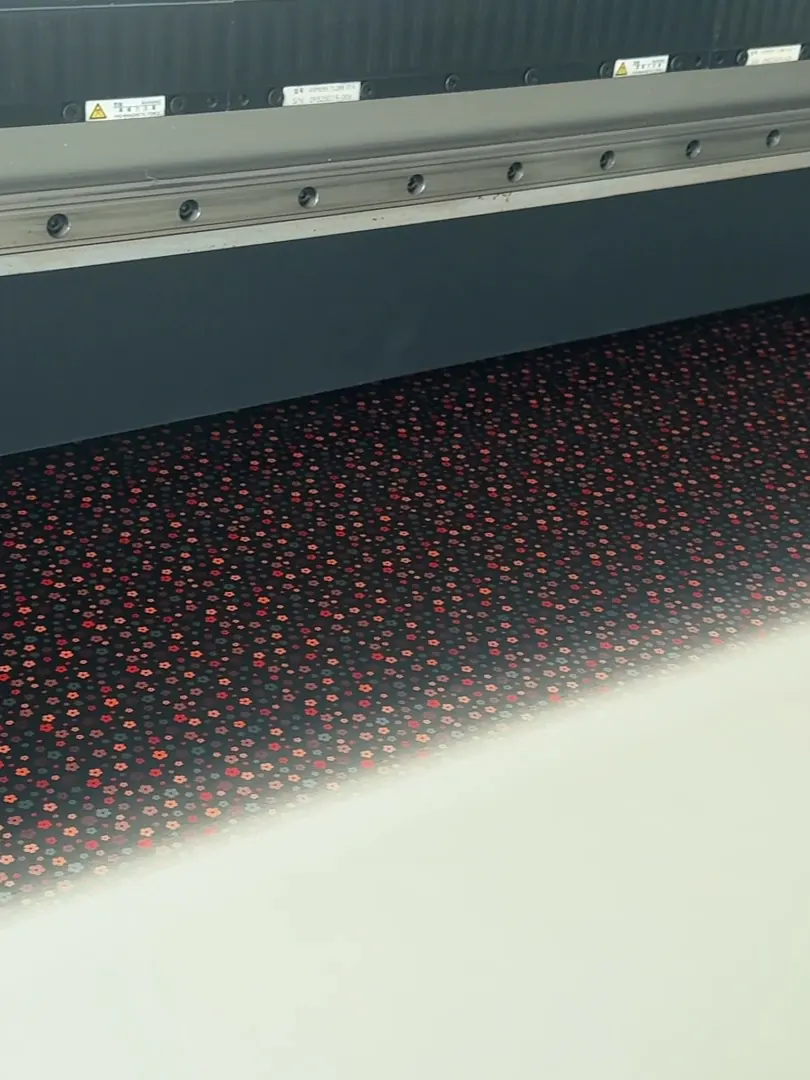
UV curing uses ultraviolet light to start a photochemical reaction that hardens the ink. Wikipedia describes it as a low-temperature, high-speed and solventless process. Digital printing in general is the method used for small-run jobs, because the image goes straight from file to surface.
That is why our custom printed PU mat page lists printing from 1 piece. The mat sits on a flatbed printer and the design prints directly onto it.
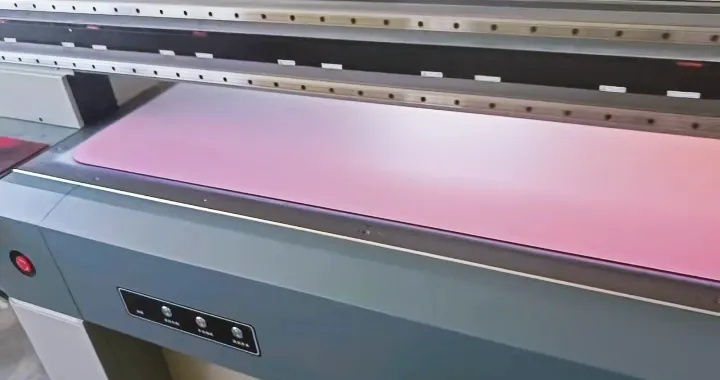
A flatbed printer running a pink mat at the factory.
Laser engraving: clean single-tone marks
Laser engraving renders a design by physically cutting into the object to remove material. It uses no ink and no tool bit that touches the surface. In yoga mats we commonly use it for alignment lines and logos. Our laser station is enclosed with fume extraction.
The mark has no colour of its own: it shows as a contrast or relief in the mat surface. Choose it when you want a quiet, premium look instead of artwork.
Embossing and debossing: pressed-in logos
Embossing presses a raised or recessed pattern into a sheet. In our process, sheets are sliced to thickness, embossed and stocked before finishing, so the texture or logo is part of the mat surface. A logo can be added by printing, laser engraving or debossing.
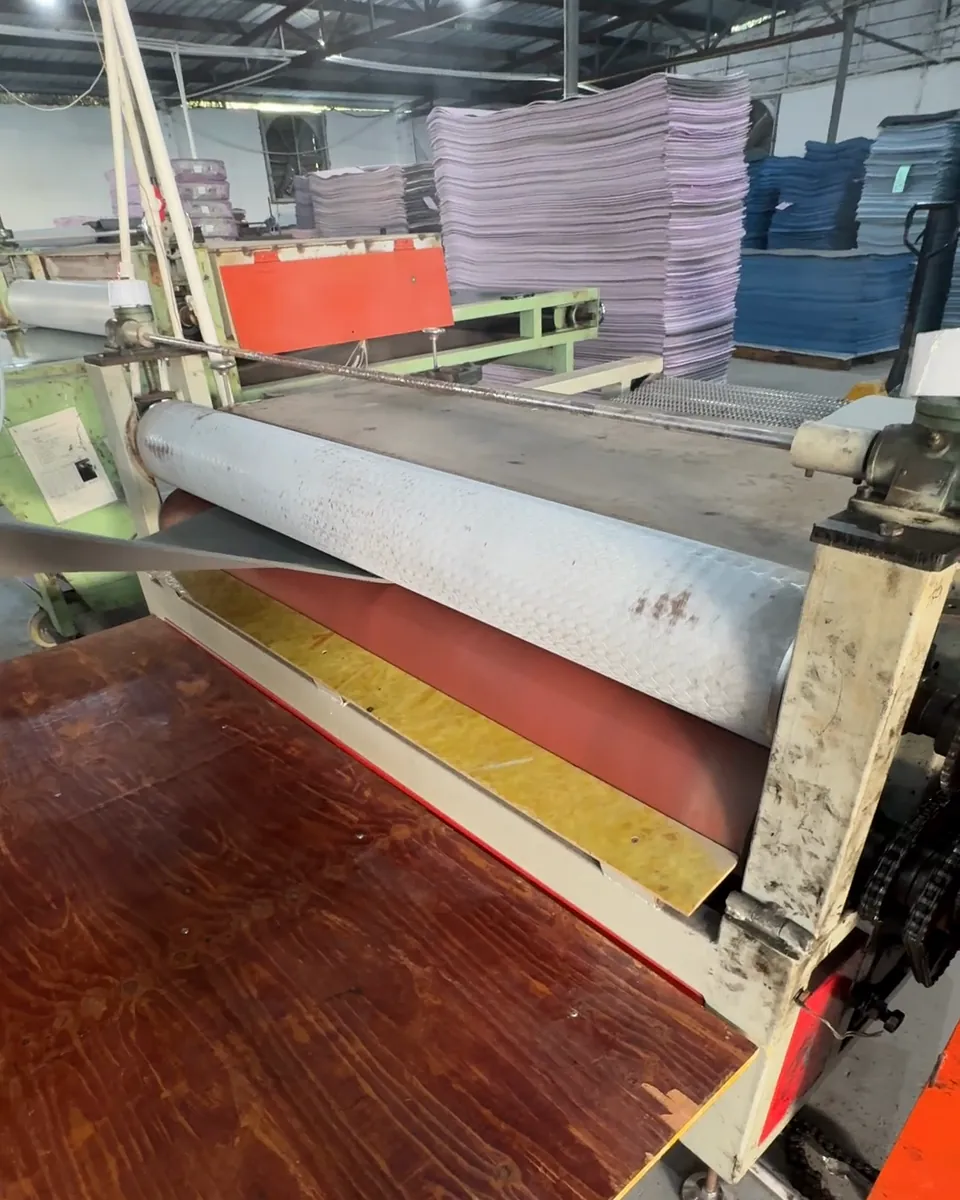
A mat sheet passing through an embossing roller.
How to choose
- Full-colour artwork or a one-off design: UV print.
- Alignment lines or a minimal logo: laser engraving.
- A tactile logo or surface texture on every mat: embossing or debossing.
- A brand mark in one or two flat colours on straps: screen print.
- Combine them: an embossed texture with a printed or engraved logo is possible; confirm the combination on a sample.
What to put in the brief
- Artwork file (vector for logos) and the placement on the mat.
- Mat material, thickness and size.
- Full colour or number of colours.
- Whether the mark must be tactile.
- Test reports your market needs, such as Prop 65 for California.
We do not publish a price per method. Cost and any method-specific minimum are confirmed in the quote.
Key facts
- SANFAN finishes mats in-house: screen printing, digital/UV printing, laser engraving, cutting and OEM packaging.
- Printed PU yoga mats can be ordered from 1 piece.
- SANFAN MOQ for TPE mats is 100 pcs per design and colour; PU or rubber bulk OEM is 300 pcs.
- Laser engraving removes material and uses no ink.
- A Prop 65 test report is held for a printed PU yoga mat; RoHS 2.0 test reports cover our mat materials.
- Samples take about 7 days; sample fee and shipping are confirmed in the quote.
- SANFAN has made yoga mats since 2013 in Jinjiang, Fujian, with 10 production lines.
FAQ
Which method gives a full-colour all-over design on a yoga mat?
UV (digital) printing. It prints the artwork directly onto the mat surface, so full-colour designs do not need a separate screen for each colour. At SANFAN, printed PU mats can be ordered from 1 piece.
Which method is best for a simple logo or alignment lines?
Laser engraving is commonly used for alignment lines and logos, and embossing or debossing suits a logo pressed into the surface. Both are single-tone marks, so choose them for a clean branded look rather than colour artwork.
Does laser engraving use ink?
No. Laser engraving renders the design by removing material, with no inks or contact tool bits, so there is no ink to fade. The mark is a relief in the surface, not a coloured print.
Is there a minimum order for each method?
Our confirmed minimums are by material: TPE 100 pcs per design and colour, PU or rubber bulk OEM 300 pcs, and printed PU from 1 piece. The minimum for a specific logo method is confirmed in the quote.
Are printed yoga mats tested for chemicals?
We hold a Prop 65 test report for a printed PU yoga mat and RoHS 2.0 test reports for our mat materials. Prop 65 is a California warning law administered by OEHHA, so buyers selling there should keep the test report on file.
How do I brief a factory on the print?
Send the artwork file, the mat material and size, where the design sits, and the number of colours or whether it is full colour. Ask for a sample, which we turn around in about 7 days; sample fee and shipping are confirmed in the quote.
Related pages
- Custom printed PU yoga mat, from 1 piece
- PU and rubber yoga mats
- TPE yoga mats
- Factory capabilities
- One-piece custom printed PU yoga mats
Sources
External references checked on 2026-11-12. None of these organisations is affiliated with SANFAN.
- Wikipedia — UV curing: photochemical hardening; low-temperature, high-speed, solventless.
- Wikipedia — Laser engraving: removes material, no inks or contact tool bits.
- Wikipedia — Digital printing: direct file-to-surface printing, used for small runs.
- OEHHA — About Proposition 65: California warning requirements for listed chemicals.
Have artwork for a mat? Send it to sales@fjsanfan.com. We give a first reply within 2 hours on working days (Mon–Sat, 9:00–22:00 China time). Request a quote