
The three frame families, and who each one is for
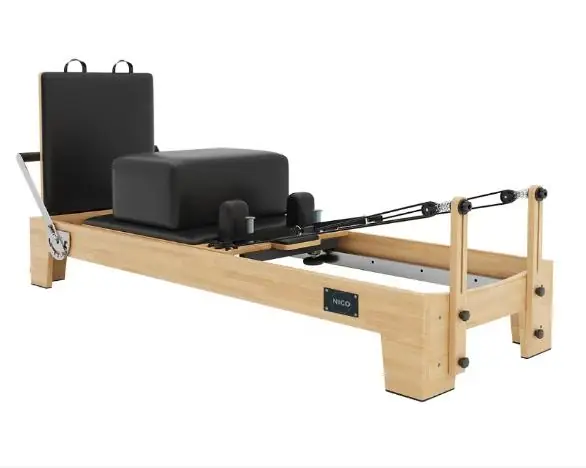
Across our 2026 range, 46 reformer models sit in three lines. They are not three price tiers of the same machine — they are three different answers to "where will this live and who will move it".
| Line | Models | Frame material in the catalogue | Typical buyer |
|---|---|---|---|
| AL — aluminium | 27 | Aluminium alloy (some models carbon steel) | Commercial studios, multi-site fleets, hotels |
| Fold — folding | 8 | Maple, oak, aluminium depending on model | Home studios, small apartments, mobile trainers |
| Wood — solid wood | 11 | Maple, oak | Boutique studios, brands that sell on look and feel |
The full model list, line by line and in catalogue order, is on the reformer range page; the tower variants (11 models) are on the reformer tower page.
What you can actually read off a packing list
Two numbers decide whether a container maths out: packing size and gross weight. Both are printed per model in the 2026 catalogue, so they are the honest first filter. A few entries from our own table, exactly as published:
| Model | Material | Packing size A | Packing size B | Gross weight |
|---|---|---|---|---|
| AL 14-M3 | Aluminium | 1870 × 930 × 590 mm | 1670 × 930 × 480 mm | 220 kg |
| AL 18-M5 | Aluminium | 1770 × 800 × 600 mm | 1680 × 720 × 470 mm | 200 kg |
| AL 19-F | Aluminium | 2300 × 710 × 450 mm | — | 145 kg |
| AL 21-mini pro | Aluminium | 2210 × 640 × 300 mm | 800 × 510 × 710 mm | 120 kg |
| Fold 9-CA | Aluminium | 1150 × 700 × 370 mm | 720 × 450 × 270 mm | 65 kg |
| Wood 1 A-3in 1 | Maple | 2570 × 810 × 740 mm | — | 200 kg |
Two habits worth building here. First, when a model lists packing size A and B, ask which one ships — some models can travel knocked down or as a split carton, and the difference is hundreds of millimetres of container space. Second, do the door maths before you fall in love with a model: a 2.3 m crate does not go through a 0.9 m studio doorway, and a 220 kg case needs a route, not a person. The layout and delivery guide walks through the clearance numbers.
Folding is a logistics decision, not a cheapening one
The Fold line packs down to a fraction of a full-size footprint — the Fold 9-CA packs at 1150 × 700 × 370 mm, which is what makes it viable for a home studio that doubles as a living room. What you give up is the ability to run two full-size machines side by side on a shared rail. If the buyer's floor plan already has the space, a fixed frame usually wins; if the floor plan is a spare bedroom or a car boot, folding wins. Decide with a floor plan, not a catalogue photo.
Five decisions to lock in writing before the deposit
- Frame and carriage colour, by pantone or physical swatch reference — not "grey".
- Upholstery colour and texture, with the cleaning regime the buyer will actually use stated up front, because that is what decides the material choice.
- Which packing configuration (A or B) applies to each model you order.
- Branding method: logo plate, stitched label, frame print or packaging print — each has a different minimum and a different lead time.
- Spare part list for the models in the order. Fleet buyers who skip this end up buying whole units to fix one part.
Sampling: what to inspect on the sample, not the spec sheet
Agree the sample first, then inspect it — not the other way round. On a reformer sample, the things that actually get disputed later are:
- Rail straightness and carriage roll, checked by hand over the full travel.
- Whether the frame colour matches the approved swatch under daylight, not studio light.
- Whether the model name on the label matches the model name on the packing list and the catalogue page. This sounds trivial and is the most common source of a wrong-shipment claim, because two lines in a range can reuse a similar model suffix.
We run this as a written golden-sample report with photos, signed by both sides. Ask any supplier for the same document; a factory that already produces it is a factory that can repeat the sample.
Where to go next
Read the apparatus explainer if you are still choosing between a reformer and a tower; read sourcing Pilates equipment from China if you have already picked the model and now need the specification and QC gates. The whole range starts at the Pilates equipment hub.
Frequently asked questions
What is the difference between an aluminium and a wood Pilates reformer?
Aluminium frames are chosen for commercial fleets, multi-site standardisation and hotels, where units are moved and cleaned often. Wood frames (maple or oak in our 2026 range) are chosen by boutique studios and brands that sell on look and feel. Both appear in the same catalogue with published packing sizes and gross weights, so the fastest way to compare them on facts is to read those two columns side by side.
How do I choose between a folding and a fixed reformer?
Decide from the floor plan, not the catalogue photo. If the space can hold a full-size machine and the buyer wants two units on a shared rail, a fixed frame is the better fit. If the space is a spare bedroom, a small studio or a vehicle, a folding frame such as Fold 9-CA — which packs at 1150 × 700 × 370 mm — is the model that actually gets used.
What should I check on a reformer sample before approving bulk?
Rail straightness and carriage travel by hand, frame colour against the approved swatch in daylight, upholstery colour and texture, and model-name consistency between the label, the packing list and the catalogue page. Ask for a signed golden-sample report with photos so the approved sample is a document, not a memory.
Why do some models list two packing sizes (A and B)?
Because those models can ship in more than one configuration — for example knocked down or as a split carton. The difference can be hundreds of millimetres of length, which changes container loading as well as whether the crate passes through the studio doorway. Always confirm which configuration applies to your order.
Can I put my own brand on a reformer?
Yes — branding can be carried on a logo plate, a stitched label on the upholstery, the frame itself or the packaging, and each method has its own minimum quantity and lead time. Specify the method, the artwork file type and the exact position on the machine in writing before sampling, not after.
Our methodology
Every packing size, gross weight and model count in this guide is first-party data. We measured every packed unit ourselves — the crate is closed, weighed and dimensioned by our own QC team at the plant in Jinjiang, Fujian — and where a model ships in two packing configurations, both crates are recorded separately because they are genuinely different crates. We measured 220 kg as the heaviest published crate across the aluminium reformer lines and 1150 mm as the smallest folded one — the spread between those two figures is what a buyer’s delivery route has to accept.
Two consequences matter when you compare suppliers:
- Published means measured — and measured means packed. The figure describes the crate that has to arrive at your door, not the assembled machine in a showroom.
- Gaps stay gaps. Where a model’s material or gross weight is not disclosed, the table shows “—”. We do not estimate a number to fill a cell.
Sources
Two general references are used for the vocabulary in this guide. Neither is a product claim, and neither is affiliated with SANFAN.
- Pilates — the movement system, and the conventional names for its apparatus.
- Joseph Pilates — the origin of the method this equipment is built for.