
The one-line version
| Apparatus | What it is | Main job in a studio | Our range |
|---|---|---|---|
| Reformer | A sliding carriage on a frame, driven by springs and ropes | Core of group and private work; the machine most clients recognise | 46 models |
| Reformer tower | A reformer with a vertical tower end carrying springs and bars | Adds standing and vertical-plane work without a second footprint | 11 models |
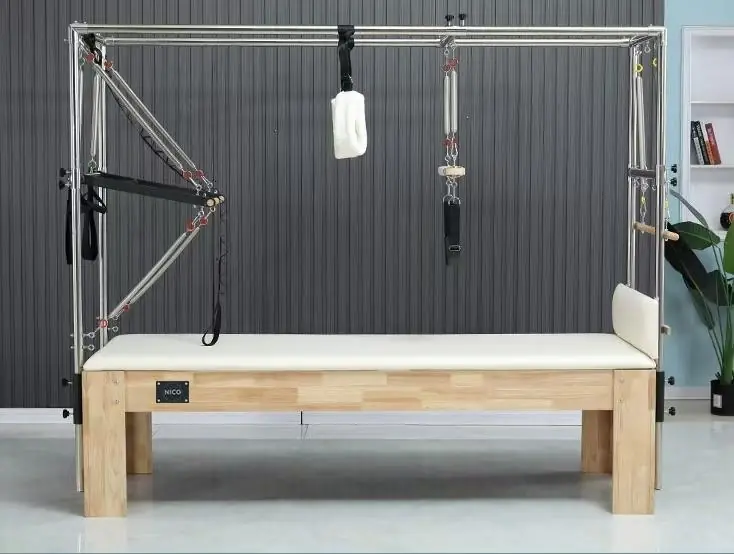
| Cadillac / trapeze table | A raised table with a surrounding frame, bars and spring attachments | Assessment, rehabilitation-style work and client variety | 4 models |
| Wunda chair | A pedal-and-spring seat unit | Compact strength and stability work; small footprint | 9 models |
| Ladder barrel | A curved barrel with a ladder rung section | Spinal articulation, stretching and stretching-adjacent work | 7 models |
| Spine corrector & small apparatus | Curved props plus rings, mats and support pieces | Classroom density, warm-ups and add-on sales | 3 + spine corrector |
Reformer vs tower: the same machine, two plans
A tower is not a different discipline — it is a reformer with a vertical end. Buyers choose it for one of two reasons: they want vertical-plane work without buying a second machine, or they want to run the same class format across a room of mixed equipment. If your plan already has full-size reformers and a separate Cadillac, the tower is optional. If you are fitting a small room and want maximum exercise range per square metre, the tower is usually the better buy. The published packing columns show why: tower models travel in the same size class as their reformer equivalents, so a tower adds capability without doubling freight.
Cadillac: the least understood line
Buyers often assume the Cadillac is the "upgrade" reformer. It is not — it is a different tool. It is the apparatus a studio uses for assessment, for clients who need supported work, and for teaching staff who need to demonstrate a wide vocabulary of exercises. Across the catalogue it is the smallest family we build, for a simple reason: a studio needs fewer of them. A room with twelve reformers and one Cadillac is a normal commercial mix; twelve Cadillacs is not a business plan.
Chairs and barrels: where the margin and the density sit
Wunda chairs (9 models) and ladder barrels (7 models) are the units studios buy second and third, because they are what make a small studio feel fully equipped. They are also the units that get pushed against a wall and forgotten, so when you specify them, specify how they get moved and stored — a barrel with no storage plan becomes a tripping hazard. Both families are built in the same workshop as the reformers, which is why ordering them in the same PO is usually the cheapest way to fill a container.
Spine correctors and props: the units that pay for themselves
Small apparatus is where classroom capacity comes from: a spine corrector or a ring lets you run a fuller room with the same floor equipment, and props are an easy add-on sale for brands selling to consumers. Our studio set page groups the small pieces that studios reorder most often.
A buying order that works for most studios
- Step 1 — reformers first. They carry the most class hours and set the room's rhythm.
- Step 2 — one Cadillac or one tower end. Whichever matches your teaching method; not both at once.
- Step 3 — chairs and a barrel. Buy one of each before buying a second reformer if space is tight; they change what you can teach more than a second rail does.
- Step 4 — props and small apparatus. Spine correctors, rings and mats to raise class density and to test as retail lines.
Gyms and hotels usually invert this: they standardise a single reformer model across sites and add towers only where the room allows. See gyms & fitness clubs for that pattern.
How to brief a quote so it comes back comparable
Always quote by apparatus family first, then model. A request that says "six reformers and two chairs" is ambiguous — the answer can differ by a metre and a hundred kilos per unit depending on which model in the family you mean. Name the model, or ask for the family sheet and pick from the published table. Both the reformer and tower pages carry the full per-model table with material, packing size and gross weight.
Frequently asked questions
What is the difference between a Pilates reformer and a Cadillac?
A reformer is a sliding carriage on a frame driven by springs and ropes, and it carries the bulk of class hours in a studio. A Cadillac — also called a trapeze table — is a raised table surrounded by a frame with bars and spring attachments, used for assessment, supported work and teaching demonstrations. Most studios run many reformers and only one or two Cadillacs, which is why it is the smallest family in our range.
Is a reformer tower the same as a Cadillac?
No. A tower is a reformer with a vertical end carrying springs and bars, so it adds vertical-plane work to a machine you are already buying. A Cadillac is a separate apparatus with a table and a surrounding frame. If your goal is maximum exercise range per square metre, a tower is usually the more efficient purchase; if you need assessment and supported work, the Cadillac is the right tool.
Which Pilates equipment should a new studio buy first?
Reformers first — they generate the most class revenue and define the room. Then one Cadillac or one tower, depending on your teaching method, not both at once. Then one Wunda chair and one ladder barrel before a second reformer if space is tight, and finally props such as spine correctors, rings and mats to raise class density.
How many models does the SANFAN 2026 range include per apparatus family?
The 2026 catalogue covers 80 models in total: 46 reformers across the aluminium, folding and solid wood lines, 11 reformer towers, 9 Wunda chairs, 7 ladder barrels, 4 Cadillacs and 3 specialty pieces, plus spine correctors and studio sets. Each model page lists material, packing size and gross weight exactly as printed in the catalogue.
Do chairs and barrels ship in the same container as reformers?
They can, and that is usually the cheapest way to fill a container. Chairs, barrels and reformers are built in the same workshop, so they can be combined in one purchase order and one loading plan. Give us the full mix and the destination and we will propose the loading split from the published packing sizes.
Our methodology
Every packing size, gross weight and model count in this guide is first-party data. We measured every packed unit ourselves — the crate is closed, weighed and dimensioned by our own QC team at the plant in Jinjiang, Fujian — and where a model ships in two packing configurations, both crates are recorded separately because they are genuinely different crates. We measured 80 models across the 2026 catalogue, family by family: 46 of them are reformers in the aluminium, folding and solid-wood lines.
Two consequences matter when you compare suppliers:
- Published means measured — and measured means packed. The figure describes the crate that has to arrive at your door, not the assembled machine in a showroom.
- Gaps stay gaps. Where a model’s material or gross weight is not disclosed, the table shows “—”. We do not estimate a number to fill a cell.
Sources
Two general references are used for the vocabulary in this guide. Neither is a product claim, and neither is affiliated with SANFAN.
- Pilates — the movement system, and the conventional names for its apparatus.
- Joseph Pilates — the origin of the method this equipment is built for.