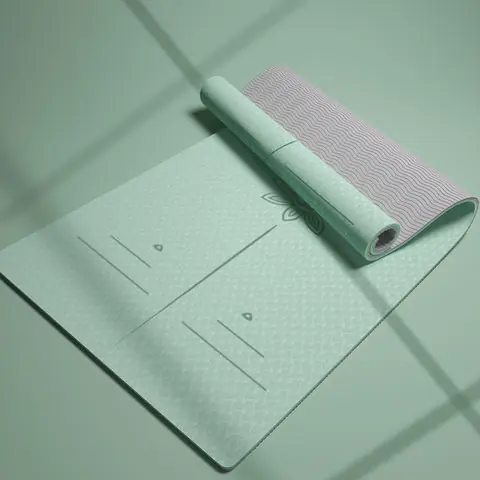
For a 183 × 61 cm (24") mat at 6 mm (1/4"), the practical hierarchy is this. TPE is the private-label default: light (about 1.1 kg), recyclable, PVC-free, reliable dry grip, and the friendliest material for small launches — we run it from 100 pcs. NBR is the budget cushioning workhorse for gym fleets: cheap and tough, but heavy (about 1.6 kg) and hard to recycle. PVC is the cheapest and most durable, but its plasticizers are exactly what EU REACH and California Prop 65 restrict, so most Western consumer brands have left it. Natural rubber grips best and tells the best eco story, at roughly double the weight of TPE. PU on rubber grips best of all when wet and owns the hot-yoga niche at the highest cost. Match the material to the channel, then confirm the choice with a physical sample, not a datasheet.
Quick comparison
Figures below are typical for a standard 183 × 61 cm (24") mat at 6 mm (1/4"). Actual values vary with density, embossing and construction.
| Material | Dry grip | Wet grip | Durability | Weight | Eco profile | Unit cost |
|---|---|---|---|---|---|---|
| TPE | Good | Fair | Good | Light (~1.1 kg) | Recyclable, PVC-free | $$ |
| NBR | Good | Fair | Very good | Heavy (~1.6 kg) | Synthetic, hard to recycle | $ |
| PVC | Good | Good | Excellent | Heavy (~1.5 kg) | Poor — plasticisers, chlorine | $ |
| Natural rubber | Excellent | Good | Very good | Heavy (~2.0 kg) | Renewable, biodegradable | $$$ |
| PU + rubber | Excellent | Excellent | Fair (top layer wears) | Heavy (~2.4 kg) | Mixed — rubber base is renewable | $$$$ |
TPE: the private-label default
TPE (thermoplastic elastomer) is the material most new brands start with, and the reasons are practical rather than fashionable. It is odourless. It contains no PVC and no phthalate plasticizers, so compliance testing is routine instead of dramatic. Its closed-cell structure does not absorb sweat, which keeps the mat hygienic through daily wiping. And at about 1.1 kg for a 6 mm (1/4") mat, it ships cheaply, which matters more in e-commerce than most buyers expect before their first freight quote.
Most private-label TPE mats are double-layer builds: a dense support base bonded to a textured grip surface, in thicknesses from 4 to 12 mm (5/32"–1/2"). The one honest weakness is wet grip. Textured TPE is reliable in dry practice and slippery once saturated. For hot yoga, the material answer is PU.
From a sourcing standpoint, TPE is also the friendliest material for small programs. We run it from 100 pcs per design and colour, with physical samples in 7 days.
NBR: the studio workhorse
NBR (nitrile butadiene rubber) is a thick, cushioned synthetic rubber. It is inexpensive, very durable and forgiving on joints, which is why gym fleets and beginner kits are full of it. The costs of that softness are weight — around 1.6 kg — a noticeable rubber smell when new that fades over weeks, and weak recyclability. If your customer is a studio buying in bulk and cleaning mats daily, NBR's toughness usually outweighs its heft. If your customer carries the mat to class, it will not.
PVC: cheap, durable, increasingly restricted
PVC mats are the cheapest to produce and extremely hard-wearing. The problem is chemistry, not performance: PVC needs plasticizers to stay flexible, and phthalates are precisely what EU REACH and California Proposition 65 target. Most US and European consumer brands have moved off PVC for exactly this reason. It survives in promotional giveaways and in markets with looser chemical rules. If you sell into the EU, budget for 6P/7P-free test reports or choose a different material — and expect retailers to ask.
Natural rubber: best grip, heaviest mat
Tapped from rubber trees, natural rubber delivers outstanding grip and cushioning, and it biodegrades at end of life. For eco-positioned brands it is a strong story with substance behind it. The practical constraints are real, though. It is heavy, roughly double a TPE mat. It carries a natural latex smell that fades slowly rather than immediately. And latex allergy labelling applies in most markets, which your packaging must account for. None of these kill the material; they just belong in the planning instead of in the reviews.
PU + rubber: the hot-yoga specialist
A polyurethane top layer laminated onto a natural-rubber base is the premium construction. The PU surface grips better as it gets wetter, which makes it the standard for hot yoga, Bikram and power yoga. It commands the highest unit cost of the group, and the PU layer wears visibly faster than TPE or NBR — sold honestly as a performance product rather than a forever mat. For the full trade-offs, see our TPE vs PU comparison.
Choosing by scenario
| You are… | Choose | Why |
|---|---|---|
| Launching a private label on a budget | TPE | Low MOQ, light to ship, PVC-free, easy to position |
| Building a premium or hot-yoga line | PU + rubber | Wet-grip performance justifies the price |
| Fitting out a studio or gym fleet | NBR or thick TPE | Durability and daily cleaning matter most |
| Leading with an eco claim | Natural rubber or TPE | Certification and honest labelling back the story |
| Buying promotional giveaways | PVC, where rules permit | Lowest cost for short-life use |
Compliance checklist before you order
- EU market: REACH compliance, ideally with 6P/7P phthalate-free test reports.
- California: Proposition 65 assessment for listed substances.
- Ask for current third-party test reports, not files from several years ago.
- Confirm the report covers the exact material and colour you are ordering — pigments can change results.
The market-by-market detail lives in our yoga mat compliance guide.
FAQ
Which yoga mat material is best for a private-label brand?
TPE is the best all-round choice for most private-label brands. It is recyclable, free of PVC and phthalates, light enough for e-commerce shipping, and supports low MOQs. PU-rubber hybrids suit premium or hot-yoga lines where wet grip matters more than unit cost.
Is PVC still used for yoga mats?
Yes, but far less than a decade ago. PVC is cheap and very durable, but it relies on plasticisers and faces tightening restrictions under EU REACH. Most US and European brands now avoid PVC for consumer mats.
Are TPE yoga mats biodegradable?
Standard TPE is recyclable but not biodegradable. It is still a better environmental option than PVC because it contains no chlorine and no phthalate plasticisers, and offcuts can be reground and reprocessed.
Which material grips best when wet?
A polyurethane (PU) top layer over a natural-rubber base gives the strongest wet grip, which is why it is the standard for hot yoga. Textured TPE gives reliable dry grip but becomes slippery once saturated with sweat.
What is the lowest MOQ for custom yoga mats?
At FUJIAN SANFAN the MOQ for custom TPE yoga mats starts at 100 pcs per design and colour. Foam rollers start at 500 pcs and most other accessories at 500–1,000 pcs. Physical samples with your logo, colour and packaging are produced in 7 days.
Do yoga mats need REACH or California Proposition 65 compliance?
Mats sold in the EU must satisfy REACH, and mats sold in California must meet Proposition 65 requirements. Most buyers also ask for 6P or 7P phthalate-free test reports. A factory should be able to provide current third-party test reports for each production batch.
Related reading
Where this fits in our own catalogue:
Deciding between materials? Tell us your target price and market and we will send physical samples in each material — with your logo and packaging — within 7 days. Get a quote.