
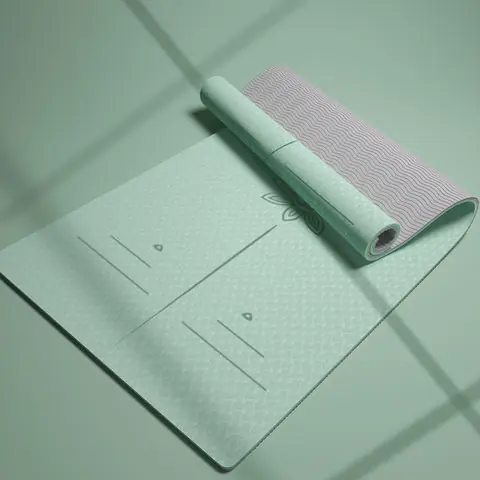
TPE (thermoplastic elastomer) is a lightweight, closed-cell, PVC-free foam that suits mid-range retail and everyday practice: a 6 mm (1/4") double-layer TPE mat weighs about 1.1 kg, prices roughly half of a comparable PU mat, and starts at 100 pcs per design and colour in our factory. PU on a natural-rubber base is the premium grip construction: the polyurethane top layer grips harder as it gets wetter, which makes it the standard for hot yoga and studio lines, at about 2.4 kg for the same size and a higher minimum (300 pcs with us). For a first launch, TPE is the safer volume product; add PU as the premium tier once you know your market. Many brands run both from the same factory and the same brand identity.
What TPE actually is
TPE is a thermoplastic elastomer: a foam that behaves like rubber but processes like plastic, which is why it can be reground and reprocessed at end of life. Most private-label TPE mats are double-layer constructions — a dense base for support bonded to a textured top for grip — in thicknesses from 4 to 8 mm (5/32"–5/16"). The closed-cell structure does not absorb sweat, so the mat wipes clean and does not carry odour. It contains no PVC and no phthalate plasticizers, which keeps REACH and California Prop 65 conversations short.
What PU on rubber actually is
A PU mat pairs a polyurethane top layer with a natural-rubber base. Polyurethane is hydrophilic: instead of getting slippery when your hands sweat, the surface grips harder. That single property explains its position. Hot yoga, Bikram and power yoga studios specify PU because slip is the one failure they cannot tolerate. The trade-offs are weight, a delicate surface that wants gentle cleaning, and a unit cost roughly double TPE.
Side by side
| Property | TPE (double-layer) | PU + natural rubber |
|---|---|---|
| Weight, 6 mm 183 × 61 cm (24") | ~1.1 kg | ~2.4 kg |
| Dry grip | Good, textured surface | Excellent |
| Wet grip | Fair — slippery when saturated | Excellent — improves with sweat |
| Lifespan, home use | 2–3 years | Longer with proper care |
| Lifespan, daily studio use | 12–18 months | Longer; surface wears visibly first |
| Unit cost | Reference point | Roughly double |
| MOQ with us | 100 pcs / design & colour | 300 pcs |
| Cleaning | Damp cloth, forgiving | Gentle mat wash, air-dry, never fold wet |
Grip: the physics of sweat
This is the honest dividing line between the two materials. Textured TPE relies on surface pattern and compound tack for dry grip, and it is genuinely good at it for home and gym practice. Add enough moisture and the water film sits on top of the closed-cell surface, and grip drops. PU does the opposite: moisture wicks into the polyurethane layer and increases the contact between skin and surface. If your product line targets hot yoga specifically, budget for PU despite the cost, because a slipping mat generates returns and one-star reviews faster than any material saving can offset.
Cost and where the money goes
TPE is cheaper per unit for two reasons: the raw compound is less expensive, and it processes faster, so more mats come off a line per shift. PU carries the cost of natural rubber sheet and a lamination step that TPE does not need. Within TPE, price climbs with thickness (4 mm to 8 mm), width (61 cm up to 80 or 122 cm) and finish (single colour, dual-layer, embossed logo). Within PU, base thickness and top-layer density drive the number. At equal volume, a typical private-label TPE mat lands at about half the PU price, which is why TPE dominates the sub-$30 retail segment and PU owns the premium studio tier.
Durability and day-to-day care
A quality double-layer TPE mat resists compression set and keeps its grip for two to three years of regular home practice. Daily studio use shortens that to 12 to 18 months, mostly through cleaning frequency rather than wear. PU mats last longer overall, but the surface is honest about its age: it scuffs, and it shows. That is part of the premium positioning — a cared-for PU mat signals use, like leather. Care instructions matter enough to print: PU wants a gentle mat wash and air-drying, and it should never be stored folded while damp. TPE is far more forgiving, which makes it the lower-friction choice for everyday home users.
Which material for which market
Buyers in North America and Australia lean TPE: value, light shipping weight, and an odour-free unboxing experience. Western European studios ask for PU and natural rubber, where grip and material story carry the sale. Japan and Korea favour thinner, precise-spec TPE with clean, subtle embossing. We ship to all four directions weekly, so tell us the destination and we will steer the specification toward what that shelf actually sells instead of what looks good in a catalogue.
Can one order mix both materials?
Yes, and most established brands do exactly this. A common structure is a TPE hero mat as the volume seller at an accessible price, plus a PU-rubber flagship for hot yoga and studio clients, sharing the same logo treatment and packaging language. Because both materials run on our own lines, we can sample them in the same window and consolidate the shipment. You get a two-tier range without managing two suppliers.
The question before this one: PVC vs TPE更靠前的一个问题:PVC 还是 TPE
Half the buyers who land on this page are really asking a question one step earlier: PVC or TPE? It matters because in most mat ranges, TPE has already replaced PVC. A PVC mat is cheaper and very abrasion-resistant, but it carries plasticiser odour and cannot be recycled in practice, so it increasingly fails retail and hospitality procurement. TPE is closed-cell, phthalate-free, recyclable and lighter to ship. If your brief is the cheapest mat that still sells, PVC is the honest answer and we will quote it; if your brief is a mat your buyer's compliance team will accept, start at TPE.找到这一页的买家里,有一半其实问的是更靠前一步:PVC 还是 TPE?这个问题重要,是因为在大多数项目里,TPE 换掉的就是 PVC。PVC 垫更便宜、极耐磨,但有增塑剂气味、实际上不可回收,在零售与酒店采购环节越来越难过关。TPE 闭孔、不含邻苯类物质、可回收,而且同尺寸下更轻、运费更省。如果你的目标是「还能卖得动的最便宜那张垫」,PVC 是诚实答案,我们照样报价;如果是「我买家那边的合规团队能过」,就从 TPE 起步。
Yoga Mat Materials Compared瑜伽垫材质横评 →
FAQ
Is PU better than TPE for hot yoga?
Yes. A PU top layer grips better the wetter it gets, which is exactly what hot yoga and Bikram require. Textured TPE is reliable in dry practice but becomes slippery once saturated with sweat. If your line targets hot yoga specifically, budget for PU despite the higher unit cost.
How long does a TPE yoga mat last?
With regular home practice a quality double-layer TPE mat typically lasts two to three years. Daily studio use shortens that to roughly 12 to 18 months. Longevity depends more on density and how the mat is cleaned than on the material label alone.
Can I mix TPE and PU in one product line?
Yes, and most established brands do. A common structure is a TPE mat as the volume seller at an accessible price, plus a PU-rubber mat as the premium option for hot yoga and studio clients. Both can carry the same brand identity and packaging.
Which material is cheaper to ship for e-commerce?
TPE. A 6 mm (1/4") TPE mat weighs around 1.1 kg versus roughly 2.4 kg for a comparable PU-rubber mat. That difference compounds across a container and across last-mile parcel rates, which is why TPE dominates direct-to-consumer listings.
Related reading
Where this fits in our own catalogue:
Not sure which fits your price point? Send your target retail price and market — we will recommend a material and spec, and sample it in 7 days. Get a quote.