
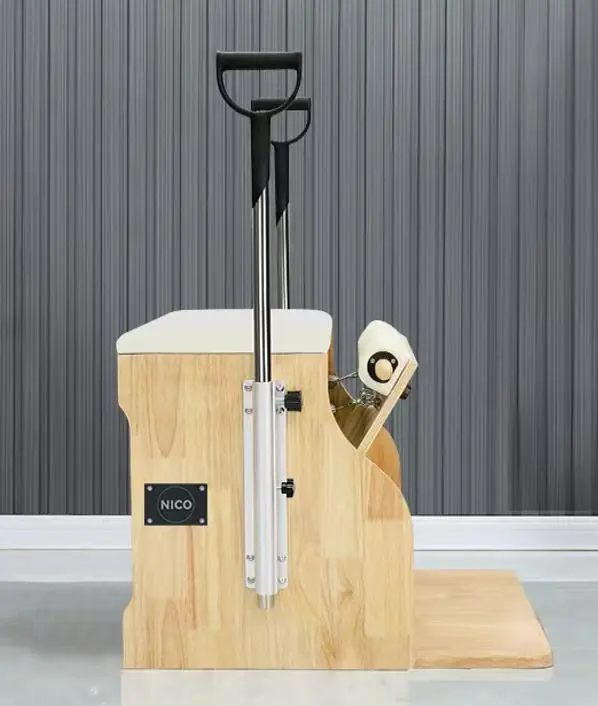
Start from usage, not from preference
Three questions separate a commercial brief from a private one:
- How many hours a day will the unit be in use, and by trained staff or by members?
- Who cleans it, with what, and how often? This decides upholstery specification more than aesthetics ever will.
- Who fixes it, and how far away are they? Service access is a specification item, not a support-ticket afterthought.
Standardise the fleet, then vary the mix
Multi-site operators should pick one reformer model and one vertical unit for the whole estate, then add variety only where the room justifies it. A member moving between branches should find the same machine under them — that consistency is worth more than a per-site optimum. In our 2026 range the aluminium line (27 reformer models) is the usual base for this pattern, because it is designed for shared, frequently moved equipment; the reformer page lists every model with its published packing size and gross weight so fleet planners can work from one table.
Small rooms, tall crates: the hotel problem
Hotels and office gyms are the hardest delivery environments: lifts, service corridors and finished floors. Two things solve most of it at quotation stage:
- Choose models with split packing. Where the catalogue lists both an A and a B packing size, the smaller configuration is what gets a unit through a lift or a narrow service door. AL 21-mini pro, for example, packs at 2210 × 640 × 300 mm or 800 × 510 × 710 mm.
- Plan the route in millimetres. The longest published crate in our range is 2800 mm, and the widest 930 mm. Those two numbers decide the delivery plan before anyone negotiates price. The layout guide has the clearance checklist.
Cleaning and wear: specify for the regime, not the showroom
Commercial cleaning is harsher than studio cleaning, and it is applied by people who are not the end user. When you specify upholstery, state the cleaning product and frequency first, then choose the colour and texture. On the frame side, remember that in multi-purpose fitness rooms the most common damage is not wear — it is people leaning equipment against radiators, stacking it badly, or dragging it. Specify how units are moved and stored, and who is allowed to move them.
Spares, service and the standardisation dividend
| Item | Why commercial buyers order it at roll-out |
|---|---|
| Spare-part list per model | One part failure should not sideline a station for a container cycle |
| Consistent fasteners across the fleet | Site staff can service any unit with one toolkit |
| Model table per family | Reorders and replacements match without photos by WhatsApp |
| Packing list and loading plan | Site-by-site delivery without re-measuring each building |
Which apparatus, by venue type
- Gyms and fitness clubs: reformer rows plus towers, with chairs and barrels in corner zones. See gyms & fitness clubs.
- Hotels, resorts and spas: fewer units, better finish, tighter delivery constraints — choose split-packing models and plan lift access. See hotels, resorts & spas.
- Boutique studios and franchises: standardise one reformer plus one tower across all sites, then differentiate with chairs and barrels. See retail & private label.
The commercial brief we answer fastest
Send: venue type and number of sites, units per site, reformer model or family, destination cities or ports, and the cleaning regime. With those five items we return a loading plan, a delivery sequence and a spare-part list — the three documents that decide whether a rollout opens on time. Start from the Pilates range overview or send the brief.
Frequently asked questions
What should a gym or hotel look for in commercial Pilates equipment?
Gather information before preferences. How many hours a day the unit will run, who cleans it and with what, who services it and how far away they are, and how the delivery route reaches the room. Then standardise one reformer model and one vertical unit across sites, and choose split-packing models where lift and service corridors are tight.
How do hotels handle Pilates equipment delivery?
By planning in millimetres and choosing the right packing configuration. Where the catalogue lists both an A and a B packing size, the smaller configuration is the one that passes a lift or narrow service door — AL 21-mini pro, for example, packs at 2210 × 640 × 300 mm or 800 × 510 × 710 mm. The longest published crate in our range is 2800 mm, so the route must be measured before the order is placed.
Should a multi-site operator standardise on one reformer model?
Yes. One reformer model and one vertical unit across all sites makes servicing, spares and reorders simpler, and it gives members a consistent experience when they switch branches. Add variety — chairs, barrels, a Cadillac station — only in rooms where the floor plan genuinely supports it.
What spare parts should a commercial buyer stock?
Ask for a spare-part list per model and order it as a line item in the original purchase order. The parts that wear are small and inexpensive compared with a station sitting idle while a replacement crosses an ocean. Consistent fasteners across the fleet also let site staff service any unit with a single toolkit.
How do cleaning regimes affect Pilates equipment specification?
They decide upholstery choice. State the cleaning product and frequency before choosing colour and texture, because commercial cleaning is applied by people who are not the end user and is harsher than studio cleaning. On the frame side, specify how units are moved and stored, since dragging and bad stacking cause more damage in shared fitness rooms than ordinary wear.
Our methodology
Every packing size, gross weight and model count in this guide is first-party data. We measured every packed unit ourselves — the crate is closed, weighed and dimensioned by our own QC team at the plant in Jinjiang, Fujian — and where a model ships in two packing configurations, both crates are recorded separately because they are genuinely different crates. We measured 220 kg as the heaviest published gross weight in the range; for commercial grade planning that figure, not the frame finish, is what decides the lift and the floor.
Two consequences matter when you compare suppliers:
- Published means measured — and measured means packed. The figure describes the crate that has to arrive at your door, not the assembled machine in a showroom.
- Gaps stay gaps. Where a model’s material or gross weight is not disclosed, the table shows “—”. We do not estimate a number to fill a cell.
Sources
Two general references are used for the vocabulary in this guide. Neither is a product claim, and neither is affiliated with SANFAN.
- Pilates — the movement system, and the conventional names for its apparatus.
- Joseph Pilates — the origin of the method this equipment is built for.